
AI at Work: A Global Early-Career Perspective
A survey of Generation alumni on how AI is showing up in their jobs
Download Report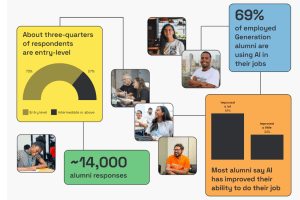
AI at Work: A Global Early-Career Perspective
How is AI changing frontline work? How widespread is its adoption? What is the day-to-day impact on employees? While debate persists about whether AI may yet spark a long-term “jobs apocalypse”, increasingly such practical questions have become top of mind.
In our 2025 report, we sought initial answers by surveying Generation alumni who had graduated in the previous two years. This year, we broadened our lens to deepen the value and statistical reliability of our insights.
We increased respondents from approximately 5,500 in 2025 to about 14,000 in 2026 by including three different Generation populations: alumni in their first year out, alumni taking our AI upskilling courses, and alumni two to six years after the program. They work across 17 countries; about three-quarters are in entry-level roles, and 75% are under 30.
The result is a rare view of how AI is changing everyday work for people too often missing from the conversation: how widely they use it, how they learned, what difference it makes, and where it is not yet translating into career progress.
of employed Generation alumni use AI at work
of AI users say it has improved their ability to do their job
of AI users two to five years after graduating report a shift to higher-value work, while 90% report productivity gains
alumni responses across 17 countries
Most alumni are using AI, and most are self-taught
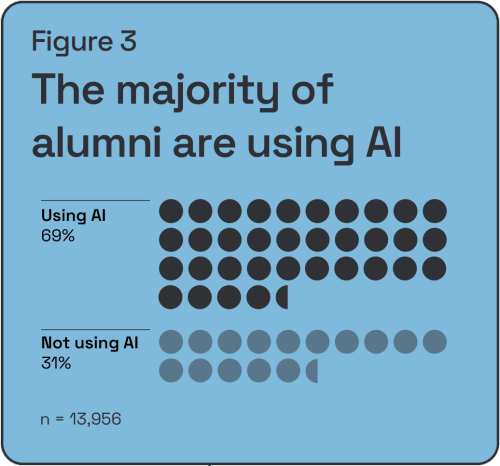
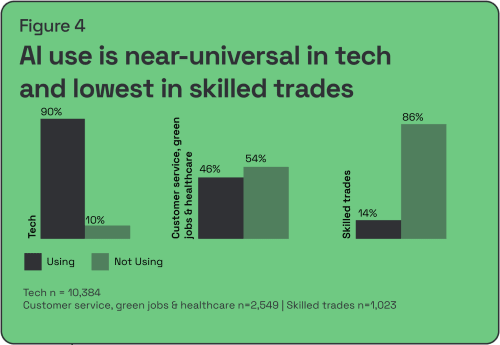
Adoption is strong: 69% of employed Generation alumni use AI at work, reaching 90% in tech roles. That compares with 46% in customer service, green jobs, and healthcare, and 14% in skilled trades, where hands-on physical work has been less affected by AI tools.
Among alumni who use AI, 86% do so at least once a week and 44% use it every day.
Most are teaching themselves. 63% use AI independently rather than because an employer requires it, rising to 73% outside tech. ChatGPT is the tool of choice (66%), followed by Gemini (34%) and Microsoft Copilot (28%).
“We use AI daily and extensively. It’s become central to how our company operates — we’ve built internal systems for our company entirely with AI assistance.”
Learning and administrative work top the list of use cases
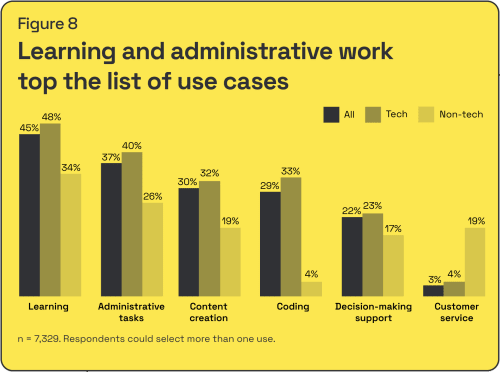
Our alumni put AI to work in varied ways, and 51% use it for more than one purpose. Learning, meaning researching topics or upskilling, is the most common use, followed by administrative tasks and content creation.
Coding is a major use in tech but rare outside it, while customer service tasks are far more common among alumni in non-tech roles.
“Data and AI is quite literally paying my bills. I use generative AI tools daily, either to help streamline communications, create content, or as a coding buddy.”
Within each sector, women and men use AI at similar rates
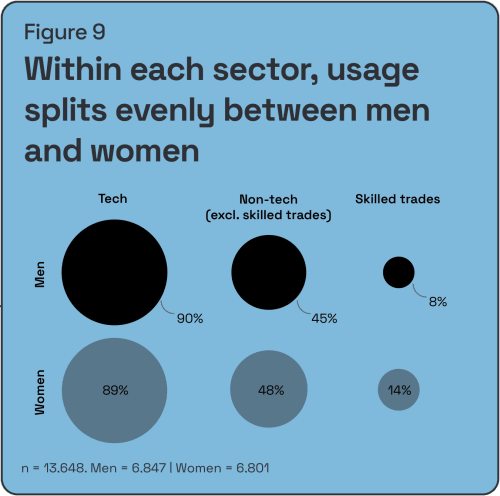
Overall gaps in AI use between women and men largely reflect which sectors they work in. Women make up 61% of respondents in skilled trades, where AI adoption is lowest, compared with 49% of respondents overall.
Looking sector by sector tells a more accurate story. In tech, 89% of women and 90% of men use AI. The gap is similarly narrow in non-tech roles (48% of women and 45% of men) and in skilled trades (14% and 8%).
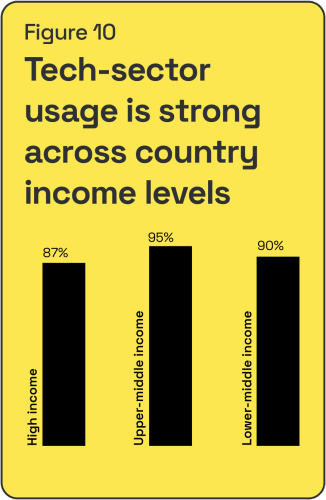
Within tech, usage is also strong and fairly consistent across country income levels.
AI is helping our alumni work more efficiently, while enjoying it more
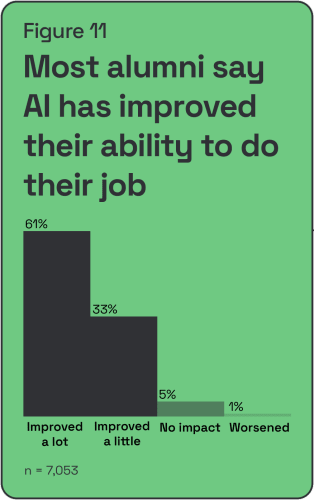
Feedback on AI’s impact is overwhelmingly positive. 94% of AI users say it has improved their ability to do their job, including 61% who say it has improved it a lot.
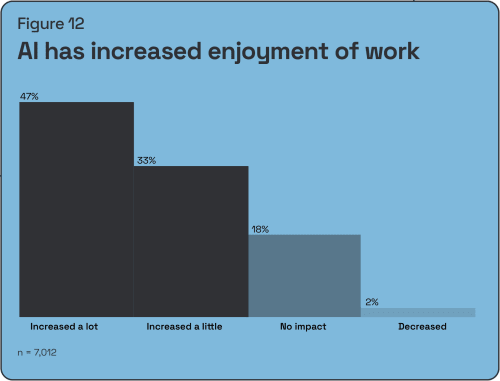
Perhaps less expected, 80% also say AI has increased how much they enjoy their job, with 47% reporting a significant increase. This holds consistently across sectors and genders.
“AI has made a big difference in both time and confidence — I’m less worried about going down the wrong path.”
Positive sentiment is strongest in lower- and upper-middle-income countries
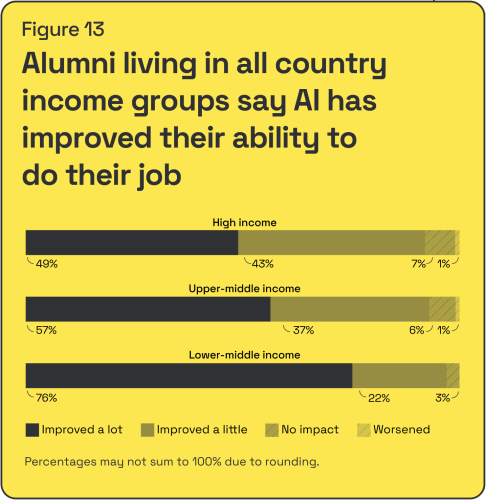
Alumni in every country income group broadly agree that AI has improved their ability to do their job. Combining “a lot” and “a little”, 92% of alumni in high-income countries say so, compared with 97% in lower-middle-income countries.
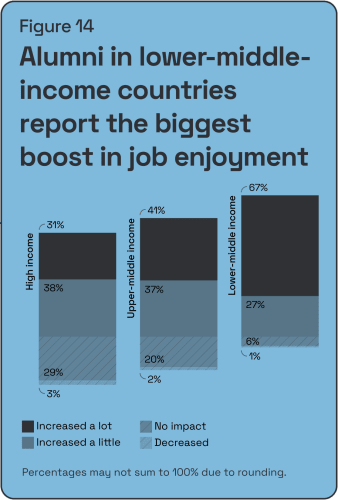
The more meaningful gap is in job enjoyment. 94% of alumni in lower-middle-income countries say AI has increased their enjoyment of work, compared with 68% in high-income countries, where “no impact” is about five times as common (29% vs. 6%). Alumni in upper-middle-income countries also report a bigger boost than those in high-income countries.
Even so, productivity gains don’t always translate into career advancement
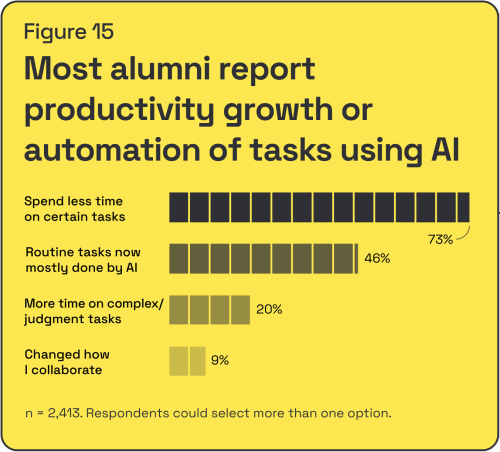
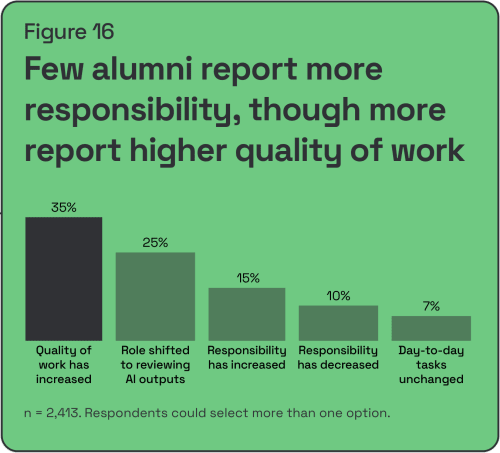
Among alumni two to five years after graduating who use AI at work, 90% report productivity growth or automation of tasks. But the picture is more mixed for career progression: 47% report a shift to higher-value work, while 57% report either productivity gains without a corresponding shift toward higher-value work, or a decrease in their responsibility or decision-making.
This pattern is most common outside tech: 68% of non-tech alumni (excluding skilled trades) report it, compared with 46% in tech. It is also more pronounced for women in non-tech roles, where 73% report it versus 66% of men, a gap that disappears within tech.
Employers could be doing much more to accelerate AI adoption
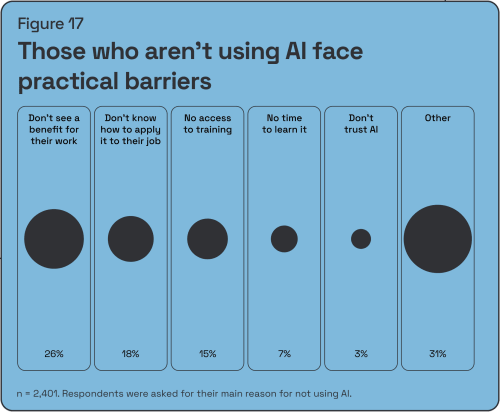
For workers not yet using AI, the barriers are practical, not a matter of trust. About three in ten alumni (31%) are not yet using AI at work, and only 3% of them give distrust as their main reason.
The most common main reasons point to unclear relevance and limited know-how: not seeing a clear benefit for their own work (26%), not knowing how to apply AI to their job (18%), and not having access to training (15%). Together, not knowing how to apply AI, lacking access to training, and lacking time account for 40% of main reasons.
These answers point to a clear opportunity for employers and workforce programs: workers are not resistant to AI. They need clearer onboarding and concrete use cases for their specific role.
“It has allowed me to complete repetitive tasks faster and to create things more efficiently, as it provides a starting point that sparks inspiration. Using AI enables me to explore more complex topics more quickly.”
Generation’s AI upskilling: structured training closes the gap
Generation now offers alumni free, online AI upskilling courses. In 2026 alone, more than 6,000 alumni have enrolled in profession-specific or generalist AI courses. We surveyed alumni right after they finished a course, and again about 90 days later.
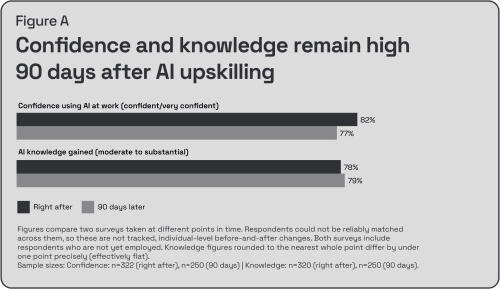
Confidence dips slightly with time, a common pattern after skills training. Right after training, 82% feel confident or very confident using AI at work, and 77% still do 90 days later. Knowledge gained holds essentially steady, at 78% right after and 79% at 90 days.
The two surveys asked about productivity differently, so we report them separately. Right after training, 83% expected it to make them quite a bit or a great deal more productive. Ninety days later, 93% of alumni who are employed and using AI at work said AI had improved their ability to do their job, including 67% who said it had improved it a lot.
These figures compare two surveys taken at different points in time, so they are not individual-level before-and-after changes.
About the survey
The findings draw on three Generation surveys fielded between Q2 2025 and Q2 2026: post-program tracking surveys of alumni in their first year, intake forms for our AI upskilling programs, and annual surveys of alumni two to six years after graduation. Results are weighted by country and sector, based on each group’s relative share of graduates. The full methodology is in the report.
This marks the 2nd year that Generation has surveyed alumni globally on this topic — you can view last year’s results here.
Acknowledgements
This report was funded by Salesforce. We are grateful to them and to all our funders, who make it possible for Generation to advance its mission.