
AI is making early-career workers more productive, but not always helping them get ahead
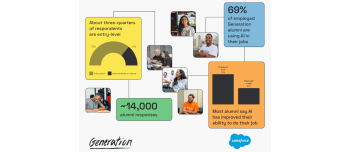
New global research from Generation finds that AI is helping early-career workers get more done, but the time it saves is not yet translating into greater responsibility.
- 90% of AI users two to five years after graduating report productivity gains, but fewer than half (47%) see a shift to more complex or higher-quality work
- AI is improving working life: 94% of users say it has improved their job performance and 80% say it has made their work more enjoyable
- The research draws on approximately 14,000 survey responses from Generation alumni across 17 countries, in technology, customer service and sales, healthcare, green jobs and skilled trades
AI at Work: A Global Early-Career Perspective 2026, developed with support from Salesforce, builds on the research we published last year with a smaller sample. This year’s survey includes approximately 14,000 alumni across 17 countries. Around three-quarters are in entry-level roles, 75% are under 30, and only around a quarter hold a university degree.
Unlike much of the existing research on office-based professionals, the study captures the experiences of workers across a much wider range of industries, and at an earlier stage in their careers. The findings raise a question for employers: is the time AI saves being used to help workers build new skills and take on more challenging work, or simply to complete tasks faster?
AI is saving workers time, but is not transforming their jobs
Among AI users surveyed two to five years after completing Generation’s training programs, 73% say they spend less time on certain tasks, and 46% report that routine tasks are now largely automated.
Yet only one in five say they are spending more time on complex tasks that require human judgment or interpersonal skills, and just 15% report taking on greater responsibility.
Overall, 57% report productivity gains without a move toward more challenging or higher-quality work, or have seen their responsibilities or decision-making power reduced. The gap is wider outside technology. More than two-thirds of workers in non-tech roles, excluding skilled trades, fall into this group, compared with 46% of workers in tech.
AI is improving job performance and making work more enjoyable
Across all sectors, 69% of employed Generation graduates use AI at work, rising to 90% in technology roles. Among users, 86% engage with it at least once a week and 44% use it every day.
The benefits are widely felt. Almost all AI users (94%) say AI has improved their ability to do their job, including 61% who say it has helped a lot. Four in five (80%) say it has made their work more enjoyable, with 47% reporting a significant difference.
The effect is strongest in lower-middle-income countries, where 94% of respondents say AI has increased their enjoyment of work, compared with 68% in high-income countries.
Workers are embracing AI on their own, but many still don’t know where to start
Employees are not waiting for their employers. Nearly two-thirds (63%) of AI users say they use it independently, rising to 73% in non-tech sectors. They use it for researching topics and learning new skills, administrative tasks, content creation and writing code.
Still, almost a third (31%) of those surveyed do not use AI at work. For most, the issue is not distrust but uncertainty about how it could help. Among non-users, 26% don’t see a clear benefit for their work, 18% don’t know how to apply AI to their role, and 15% lack access to training. Just 3% cite distrust as their main reason.
The AI gender gap is more about where people work
The research challenges the early consensus that women are less likely than men to adopt AI. Within the same sector, men and women use it at remarkably similar rates.
In technology roles, 89% of women and 90% of men use AI at work. In non-tech roles, excluding skilled trades, the figures are 48% for women and 45% for men. In skilled trades, where overall adoption remains low, women are more likely to use AI than men (14% compared with 8%).
The findings suggest that differences in AI adoption between women and men have more to do with the industries they work in than their willingness to use the technology.
What our leaders say
Dr. Mona Mourshed, Founding Global CEO of Generation, said:
“AI is already changing how people work, but working faster isn’t the same as moving forward in your career. If employees are saving time without being given more challenging work or greater responsibility, as we see in this year’s survey of Generation alumni, then we’re missing an important opportunity.
Employers need to think about what happens to the time AI gives back to workers. Can people use it to develop new skills, take on more responsibility, or do work that requires judgement and creativity? Those are the changes that could make a real difference to people’s careers and spark new innovations within organizations. And we need to make sure everyone has the skills and support to benefit, not just those who are already confident experimenting with the technology.”
Becky Ferguson, SVP at Salesforce, said:
“AI skills are opening doors for early-career workers. We’re proud to support Generation’s efforts to prepare people for the jobs of today and tomorrow, and excited about the insights this report brings to the field.”
Read the full report: AI at Work: A Global Early-Career Perspective 2026