
Five data insights from Generation’s work over the last decade

Over the course of our first decade at Generation, we have consistently kept data at the core of what we do. We’ve learned a lot about the how and why of making economic mobility possible, including how to support people to gain skills, get jobs, and earn life-changing incomes. In this piece, we share five data insights that stopped us in our tracks and are shaping the way we do our work.
Generation trains and places people into new careers through short, profession-specific employment programs. We work in 17 countries across 40 professions spanning customer service/sales, green jobs, healthcare, skilled trades, and technology. Of our learners, 70% have secondary school/vocational education attainment or lower, 50% cannot cover their daily needs or receive financial assistance, and 53% are women.
In the early days, our commitment to using data and using it well meant carefully tracking our first learners’ progress, their graduation, and their placement into jobs. Now, 145,000+ graduates and $2.2 billion in life-changing salaries later, it is all of that plus much more. We’ve amassed more than 57 million data points and we track progress along three dimensions: breadth (number of graduates), depth (job placement and outcomes within 3-6 months of program completion) and durability (employment, income, and well-being outcomes up to five years post program). It’s this work that has yielded the most interesting insights over time.
1. Missing just one day of class in the first two weeks of the program makes someone four times less likely to graduate; and even if they do, they are 25% less likely to get a job.
Success takes hold in the opening days of a Generation program. As one measure of that success, we track graduation rates and job placement rates. Cumulatively, across all programs, 85% of learners graduate and 83% of graduates are placed in jobs within six months. Those are important overall markers of impact. When you disaggregate the data, we also see that there are similar outcomes across genders, education levels, and prior work experience. In fact, there is less than a five percentage point difference in outcomes across those subgroups.
We wanted to better understand what might help us anticipate which learners were most likely to face difficulties in graduating and getting jobs so that we could intervene sooner with support to keep them on track. And that’s where we found that missing just one day of class in the first two weeks of the programs makes someone—across all types of learner backgrounds—four times less likely to graduate and even if they do are 25% less likely to get a job. This analysis guides us to intervene early and proactively with in-program support that boosts class attendance.
2. If someone continues to be employed two years after Generation, then they are likely to stay employed.
Coming into Generation’s programs, 90% of learners are unemployed. The program flips that on its head, with 83% of graduates placed in jobs within six months. And at two years post-program, 75% are employed and then that largely remains stable through year five. Simply put, the change lasts.
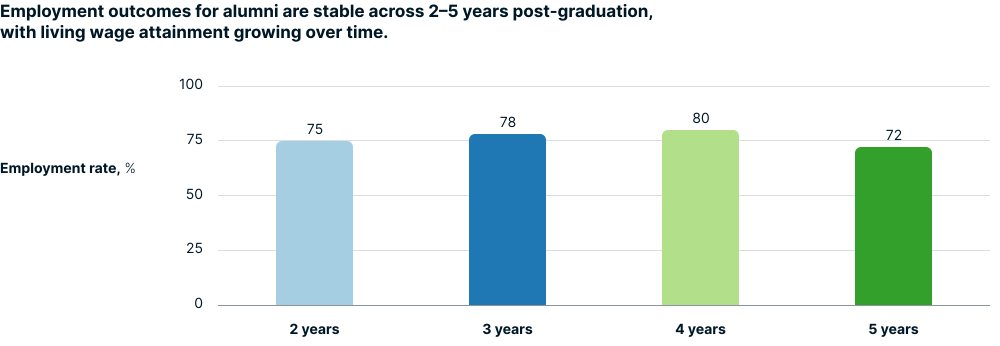
Obtaining a high-quality job is an important driver of this stability and career growth over time. Achieving a quality job—as measured by stable job contracts, full time employment, pay that supports a decent standard of living, supportive social environment and a sense of purpose at work—as the first job after training is also an important predictor of living wage* attainment at two to five years post-program. For Generation graduates, stable job contracts (particularly permanent, indefinite contracts) and full-time job roles are the strongest drivers of long-term employment retention and wage growth across all the job quality indicators.
3. Income grows consistently over time, and graduates can attain a living wage across countries and professions—but the speed of getting there varies.
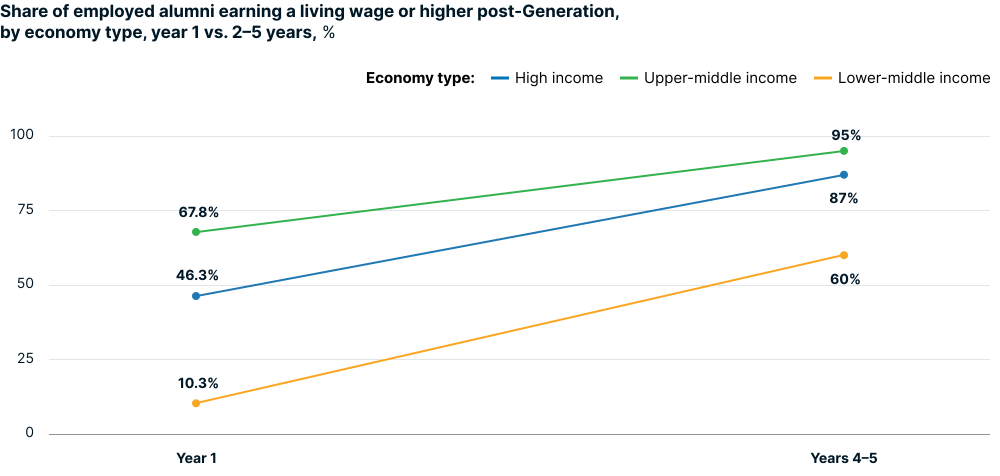
Across employed Generation alumni, 73% make a living wage or higher by 2-5 years post-graduation, but the pathways are different.
For example, at one year post-graduation, only 10% of graduates in lower-middle income countries (LMIC) are earning a living wage or higher versus 68% in upper-middle income countries (UMIC) and 46% of graduates in high income countries (HIC). But these numbers steadily increase in all countries over the five years. While that gap remains, it narrows such that by five years post-graduation, the majority of graduates in all country income categories are earning at or above a living wage. Specifically, 59% of graduates in LMIC, 92% in UMIC, and 85% in HIC are earning a living wage by year 5 post-graduation.
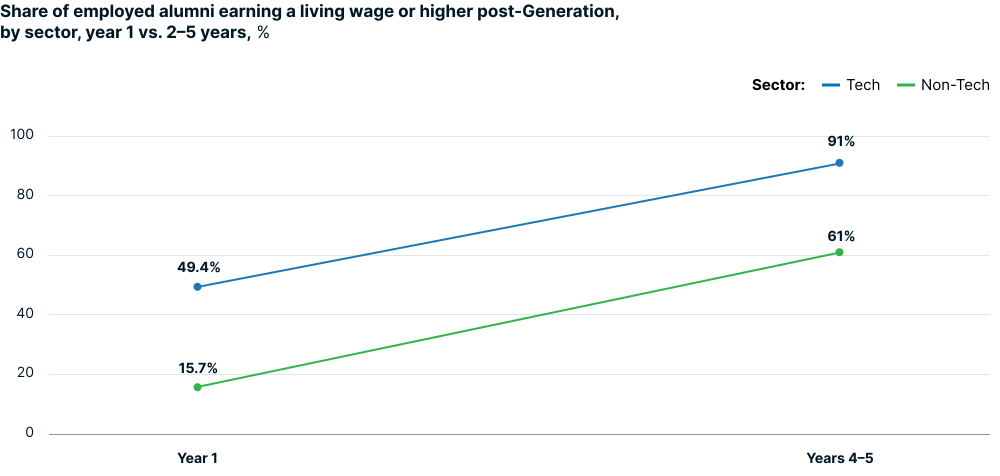
What drives this variation? Profession mix in the region is the main difference. In the tech sector, across all our regions, living wage attainment for employed alumni is 49% at year 1, rises to 86% at 2-3 years post-graduation and to 91% at 4-5 years. And, better yet, the share of alumni earning a thriving wage (1.2x local living wage) rises from 74% at 2-3 years to 87% at 4-5 years. For non-tech sector professions like customer service, green jobs, and skilled trades, the journey is more gradual : living wage attainment among employed alumni rises from 51% at 2-3 years post-graduation to 61% at 4-5 years. And then thriving wage attainment in non-tech professions rises from 29% at 2-3 yrs to 35% at 4-5 years.
Irrespective of sector, promotion is a key factor in wage increases. Fifty-eight percent of our employed alumni in year 2 post-graduation and 71% in year 5 have advanced beyond entry-level roles to intermediate and managerial roles.
We seek to continue to enable the strongest possible career growth and, by extension, living wage attainment for our alumni. First, we optimize our professions portfolio by understanding which sectors and roles support living wage attainment. To that end, we have discontinued programs that had high hiring demand but did not lead to durable living wage outcomes for graduates—including general duty assistants in India and financial services sales in Kenya. Second, we encourage our graduates to build their careers in roles related to their Generation training. Living wage attainment is 14 percentage points higher for those who have careers related to their Generation training than those who have switched to unrelated careers.
4. There is more than one pathway to high program return on investment (ROI): graduates getting living wage jobs immediately or getting average wage jobs quickly, staying employed, and improving earnings over time.
We define ROI as the increased income graduates earn over a five year period after graduation versus the full cost to train them. The income increase is either determined by estimating against a comparison counterfactual group, or against their pre-Generation status.
Generation programs have an ROI of 3-7x against counterfactuals, and graduates earn 6-22x more income upon graduating from Generation over five years, compared to their baseline situation (where 90% are unemployed upon entering our programs).
Generation Program ROI, with counterfactual
| Country | ROI of Generation programs |
|---|---|
| Colombia* | 4.4 |
| France | 3.6 |
| India | 7.2 |
| Italy | 7.6 |
| Kenya | 3.2 |
| UK | 4.9 |
* Colombia ROI is based on 2025 cost per learner data. All others are cumulative.
Generation Program ROI, versus baseline income*
| Country | ROI of Generation programs |
|---|---|
| Australia | 12.2 |
| Brazil | 6.5 |
| Chile | 6.3 |
| Colombia | 5.3 |
| France | 9.4 |
| Hong Kong (China) | 6 |
| India | 9.5 |
| Ireland | 10.1 |
| Italy | 15.8 |
| Kenya | 6.9 |
| Mexico | 22.4 |
| Singapore | 7 |
| Spain | 13.2 |
| Thailand | 15.2 |
| UK | 10.9 |
*using the Livelihood Impact Lab ROI Estimator, Livelihood Impact Fund
High ROI is influenced by the full chain of outcomes along the learner lifecycle starting with graduation rates, initial job placement levels, long term employment retention, and career and wage growth. As outlined above, the steady journey towards a living wage varies by country economy type and sector and those differences play out in the mix of factors that can drive ROI. Yet, a high ROI is achievable in all of these cases with different combinations of short-term and long-term employment rates.
ROI Trajectories
| Examples | Post-Generation short-term employment rate (<6 mths)* | Post-Generation long-term employment rate (2-5 years) | ROI |
|---|---|---|---|
| Lower middle income country | 86% | 70% | 6.9 |
| Upper middle income country | 77% | 84% | 6.5 |
| High income country | 81% | 86% | 7 |
*Share of total graduates employed
5. It costs only 1% of the total cost per learner to capture income, employment and well-being data for graduates 2-5 years post-program.
Our investment in data collection is small, but focused. Generation spends approximately 1% of the total cost per learner on gathering mid- to long-term data on employment, income, and well-being up to five years post program. We call this durability data. We conduct an alumni survey annually, and we use survey administration strategies that are optimized for the intended analytical and accuracy goals, local staffing resources, and the communication practices of alumni. This enables us to reach ~50% survey response rates, with some countries reaching close to 70%.
From the outset, we have viewed durability—whether the change lasts—as essential to informing our program operations. We observe that most stakeholders view durability data as either too hard or too costly to gather. Our experience over the past decade tells us that it does not have to be this way and can be done in a feasible and cost-effective manner.
We set expectations early during the program that we will ask for data over time, emphasizing the ways that our learners are helping future Generation cohorts by “giving back” in this way. We regularly update contact information and then use an omnichannel approach in outreach. All initial survey requests are sent through email but follow up methods vary by country. For example, in Kenya and India, where our graduates are less likely to regularly use email or complete web-based surveys, we primarily follow up by phone and achieve a strong response rate. In Brazil and Mexico, graduates more frequently use mobile messaging apps and WhatsApp is very common, so we use WhatsApp for follow-up. These approaches vary country-by-country, but we generally start with the cheapest, least resource intensive follow up method and progress to the most resource intensive method. We are persistent in our approach, using multiple touch points and activating alumni themselves to help reach their peers. And, finally, we monitor this outreach carefully, reviewing response rates weekly during our survey periods so that we can adapt our approach and ensure a sufficient sample.
Last, in parallel with gathering survey data, we engage with third party assessments and conduct near miss counterfactual analyses. These allow us to compare results and increase confidence that our survey data is representative.
Download White Paper***
Data about program outcomes is what holds us accountable to Generation’s mission. The trove of data we have gathered has led to a deeper understanding of our work along multiple dimensions: learner performance, graduate employment and income trajectories, program return on investment, and ultimately the resources we deploy to data gathering . We’ve made many adjustments to what we do and how we do it based on these analyses, and we will continue to use data to refine our mission and ensure we create lasting opportunities for economic mobility for as many people as possible.
***
*Living wage is the remuneration received that is sufficient to afford a decent standard of living for a worker and their family. For the US, UK and Ireland, we use public in-country sources. For all others, we use WageIndicator’s publicly available benchmarks for living wage, pro-rated for a single adult. On average, living wage is ~40% higher than minimum wage, though the range is broad.
- For lower-middle income countries, 96% of our learners are unemployed when joining Generation and are earning zero income. Of the 4% who were employed prior to Generation, 4.5% were earning a living wage.
- For upper-middle income countries, 87% of our learners are unemployed when joining Generation and are earning zero income. Of the 13% who were employed prior to Generation, 10% were earning a living wage.
- For high income countries, 85% of our learners are unemployed when joining Generation and are earning zero income. Of the 15% who were employed prior to Generation, 43% were earning a living wage.
Note: Our network countries fall into three World Bank economy types: lower-middle income (India, Kenya), upper-middle income (Brazil, Colombia, Mexico, Thailand), and high income (Australia, Chile, France, Hong Kong, Italy, Ireland, Singapore, Spain, the UK).
