How Strategic Workforce Development Investment Creates Lasting Economic Mobility: The Philanthropic Case for Measurable Impact

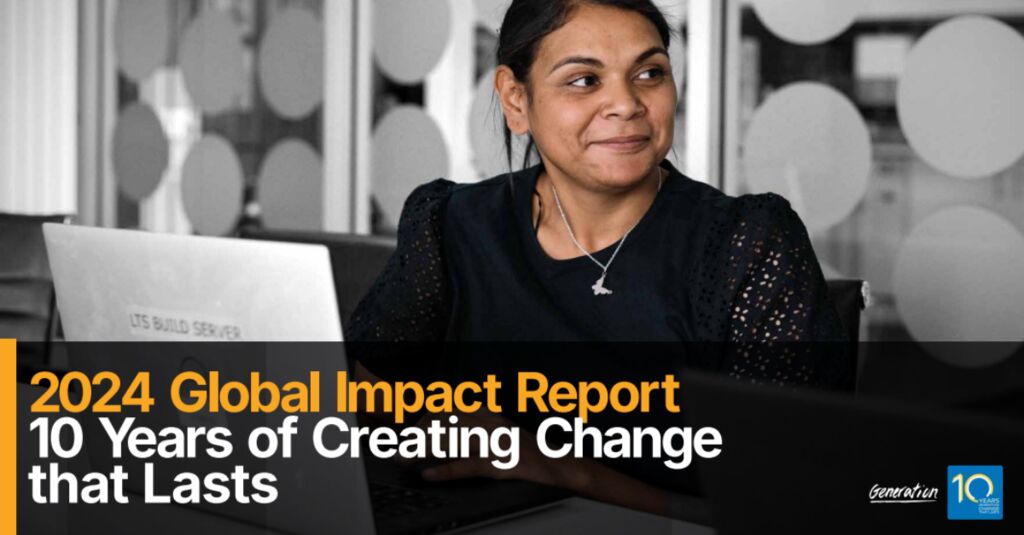
High Impact Philanthropy: Funding Skills Training for a Changing Workforce See how strategic funding for skills training drives workforce readiness, economic mobility, and measurable social impact at scale.
Read it now
Two hundred million people worldwide seek meaningful employment while employers struggle to fill 40% of entry-level positions due to skills gaps. This gap reveals a broken system—and a massive philanthropic opportunity.
Strategic funders who recognize this gap are discovering that evidence-based workforce development offers something rare: measurable social returns that compound over time. When you invest in programs that prioritize durability, measurement, and scalability, you don’t just support job placements. Your investment catalyzes economic mobility that transforms families and communities for generations.
The proof lies in the outcomes. Generation’s 137,000+ graduates have collectively earned $1.9 billion in life-changing wages.
The Philanthropic ROI: Why Workforce Development Delivers Exceptional Social Returns
Your philanthropic investment requires clear metrics and measurable outcomes. Workforce development, when done strategically, offers both immediate impact and long-term transformation that few other interventions can match.
Consider the multiplier effect that makes this investment compelling. Each Generation graduate earning 3-4X their previous income doesn’t just transform their own life. With 28% of learners supporting dependents, every successful placement touches multiple family members. Generation’s 2030 strategic plan projects that serving 400,000-500,000 cumulative learners will enable upward economic mobility for an additional 600,000-750,000 family members.
The durability data reveals why sophisticated funders are taking notice. Two to five years after graduation, more than half of Generation’s alumni earn above a living wage. This isn’t temporary assistance—it’s permanent economic mobility that breaks intergenerational poverty cycles.
Independent validation confirms these outcomes across diverse contexts. Evaluations by Mathematica and other third-party assessors demonstrate that evidence-based workforce development consistently outperforms traditional approaches. In India, graduates achieved 50% higher employment rates and 75% higher income than control groups 15 months after graduation.
For funders focused on efficiency, the timeline tells a compelling story. Graduates earn income equivalent to the full program cost within just 2-5 months of employment. This rapid return means your investment begins generating social dividends almost immediately while creating lasting change that extends for decades.
Breaking the Cycle of Poverty: How Strategic Investment Creates Intergenerational Change
Traditional philanthropy often addresses symptoms rather than root causes. Your workforce development funding attacks poverty at its source by creating pathways to economic mobility that didn’t exist before.
The transformation goes beyond individual success stories. Take Stanley’s story from Kenya. Growing up in extreme poverty in Nairobi’s Kawangware neighborhood, he seemed destined for the same struggles that trapped his family. Today, he runs his own transportation business and drives his children to school, a life transformation that extends far beyond individual success.
Stanley’s transformation illustrates a broader pattern Generation creates worldwide. Rather than providing temporary relief, strategic workforce development creates new economic pathways that communities can access for generations.
A shift in perspective can transform not just individual circumstances, but entire community expectations about what’s possible. When neighbors see Generation graduates succeeding in careers they never thought accessible, it changes how families think about their children’s futures. That’s the kind of systemic change that outlasts any single funding cycle.
For funders seeking maximum impact, this intergenerational approach offers something unique: the ability to break poverty cycles rather than simply manage their effects.
But individual transformation tells only part of the story. The real philanthropic opportunity lies in how these outcomes scale to create systemic change that outlasts any single funding cycle.
Addressing Systemic Challenges: The Scale Philanthropy Demands
Individual success stories inspire, but systemic change requires scale. Workforce development funding addresses multiple societal challenges simultaneously, creating the kind of comprehensive impact that justifies philanthropic commitment.
Skills gaps represent market failures. Philanthropy can correct them. Forty percent of employers cite skills shortages, while 200 million people remain unemployed worldwide. The disconnect reveals broken systems rather than individual deficiencies. Your investment in workforce development creates the bridges that markets fail to build naturally.
When programs prioritize potential over credentials, they naturally serve women, underrepresented communities, and people striving to overcome challenging circumstances—advancing inclusion for everyone while building economic opportunity.
For global funders, the scalability potential is particularly compelling. Programs operating successfully across 17 countries prove that effective methodologies can transcend borders and cultural differences. This means your investment in proven approaches can generate impact far beyond any single geographic region.
Related to this topic:
High Impact Philanthropy: Funding Skills Training for a Changing Workforce
The Investment Framework: How Strategic Funders Create Maximum Impact
Sophisticated philanthropic investment requires understanding how workforce development creates sustainable change at scale. The most effective approach involves four key elements that maximize both impact and efficiency.
- Partnership ecosystems multiply your impact while reducing risk. Rather than funding isolated programs, your funding supports collaborative frameworks that bring together employers, governments, training providers, and other funders. Generation works with more than 19,000 employers and 10 governments, creating shared value that extends far beyond any single investment. This collaborative approach reduces individual funder risk while amplifying collective impact.
- Shared delivery platforms generate economies of scale that maximize every philanthropic dollar. Instead of funding separate infrastructure for each program, strategic investment develops curricula, tools, and digital systems that can be adapted across contexts. This approach reduces costs while maintaining quality—exactly what your efficient philanthropy demands.
- Effective programs focus on systems change rather than traditional charity approaches. Rather than just filling existing gaps, effective programs transform hiring practices and education-to-employment systems. They create new pathways for economic mobility that persist beyond any single funding cycle, ensuring your investment continues generating returns long after initial deployment.
- Innovation drives exponential expansion potential. Remote training models extend reach to under-resourced communities that traditional programs couldn’t serve. Digital infrastructure enables quality delivery regardless of geographic constraints—multiplying the impact of your philanthropic investment across borders and contexts.
The Durability Imperative: Why Long-Term Impact Matters
Traditional philanthropy often measures success through immediate outputs rather than lasting outcomes. Your workforce development investment prioritizes durability—the kind of sustained change that justifies your philanthropic commitment.
Medium and long-term measurement reveals true impact. While many programs track only training participants or initial job placement, lasting transformation requires following graduates for years. Generation’s data demonstrates this difference: 76% of alumni stay employed and more than half earn above a living wage two to five years after graduation, proving that effective workforce development creates permanent economic mobility, not temporary employment.
Systemic change delivers exponential returns. The most effective programs don’t just place individuals in jobs—they transform how communities think about economic opportunity and how employers approach talent development. This transformation takes time to manifest but creates change that persists across generations.
The compound effects justify extended investment horizons. When graduates become mentors, entrepreneurs, and community leaders, the impact multiplies beyond any initial placement metrics. When you understand this dynamic, you position yourself to achieve outcomes that appear years after initial funding—the kind of lasting legacy that defines transformational philanthropy.
Looking Forward: The Philanthropic Opportunity
The next decade will determine whether workforce development reaches its potential to truly transform economic inequality at scale. Your funding can drive this transformation by supporting evidence-based approaches that deliver measurable, lasting impact.
Scale is within reach. Generation’s 2030 vision targets 400,000-500,000 cumulative learners—proof that evidence-based approaches can operate at the scale required to address global unemployment and economic inequality. For funders, this represents the rare opportunity to support interventions that can achieve population-level impact.
Innovation is accelerating possibilities. Remote training models, AI-enhanced learning platforms, and data-driven personalization are expanding what’s possible in workforce development. Your early investment in these innovations positions you at the forefront of social impact evolution, with the potential to shape how the entire sector develops.
Collaborative funding multiplies impact while reducing risk. The partnership ecosystems that effective workforce development requires create opportunities for you to leverage other funders’ investments and expertise. This collaborative approach means your dollars go further while your risk decreases.
The measurement frameworks offer exactly what modern philanthropy demands: clear metrics, independent validation, and proof of lasting impact. You can invest with confidence, knowing that rigorous evaluation will track your investment’s performance over time.
Your investment in strategic workforce development doesn’t just change individual lives. It transforms communities, creates economic mobility that lasts for generations, and builds the evidence base that elevates the entire social impact sector.
The opportunity is unprecedented. The evidence is clear. The more than $1.9 billion in wages earned by Generation graduates represents just the beginning. Strategic funders who invest in evidence-based workforce development today are positioning themselves to create the kind of lasting change that defines philanthropic legacy.
Ready to explore how strategic workforce development investment can create measurable, lasting impact? Connect with Generation’s team to learn about partnership opportunities that transform communities and drive economic mobility at scale.